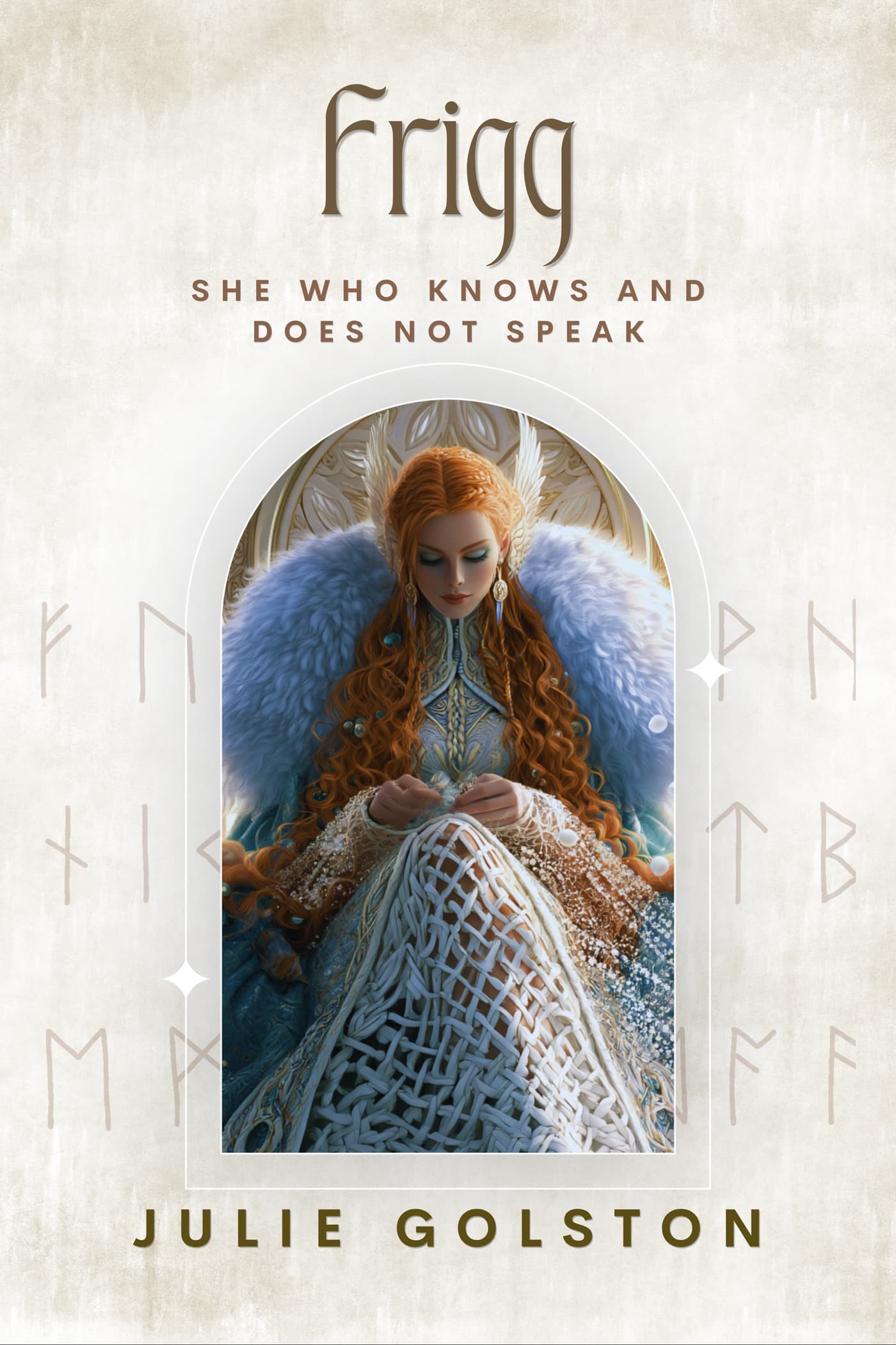
Frigg
She Who Knows and Does Not Speak
She is at the loom. She is always at the loom. Frigg—queen of Ásgarðr, wife of Odin, highest of the Norse goddesses—knows the fate of every being in the nine worlds. The Lokasenna states this plainly, in a single sentence that the scholarship has spent decades failing to take seriously: Frigg's foreknowledge she tells no one. Not because she cannot speak. Because she has decided not to. Frigg: She Who Knows and Does Not Speak is the first sustained scholarly examination of the Norse tradition's most powerful and most misread divine figure—the goddess whose silence has been consistently mistaken for passivity, whose knowledge has been consistently underestimated, and whose specific form of authority over fate, marriage, and the divine order has been obscured by centuries of reduction to the role the tradition least interesting about her: grieving mother. Frigg is not primarily a mother. She is a knower. She sits on Hliðskjálf alongside Odin and looks out across the nine worlds, and she sees everything he sees and more, and she says none of it. Her distaff is visible in the night sky—Frigg's distaff, the Norse name for Orion's belt — because the tradition understood that her weaving was cosmological work, not domestic labor. The threads she works are the threads of fate itself. Drawing on Eddic poetry, the Prose Edda, the saga literature, the place name record, comparative mythology across the Indo-European world, and the emerging scholarship on Norse female divine figures, this book examines Frigg across her full range: her relationship to Odin and what two beings sharing one throne reveals about the Norse understanding of sovereignty; her attendants and what their names encode about the functions she governs; the question of her relationship to Freyja and why the tradition kept them separate when it would have been easier to merge them; and the mistletoe — the moment when her foreknowledge and her silence collide with the event she could not prevent and did not try to. The grief of Frigg is real. It is also not the point. The point is what the grief reveals: that a goddess who knew every fate chose not to prevent this one, and that her choice was the most complete expression of what her silence has always meant. She does not speak because speaking would not help. She weaves because weaving is what can be done. The casket is sealed. The knowledge is hers. The world continues. The Hidden Powers of Norse Mythology examines the Norse tradition's most important figures with full scholarly rigor and full literary attention—for readers who understand that the quietest figures in any tradition are rarely the least powerful. Frigg knows. She is not going to tell you. But this book will.
Get Your Copy
Part of The Hidden Powers of Norse Mythology — A series dedicated to the figures whose importance the tradition and its scholarship have both consistently underestimated.